
Education rightly culminates in worship. Modern society has forgotten this, isolating intellectual and educational endeavors from religious ones. This is what has become known as the sacred-secular divide. And it's so common in the modern world that we assume this is how it's always been (it's not). In such an environment, what T.S. Eliot noted decades ago is more relevant than ever:
As the world becomes more completely secularized, the need becomes more urgent that professedly Christian people should have a Christian education, which should be an education both for this world and for the life of prayer in this world. [1]
- T.S. Eliot
At All Saints Classical Academy we are exploding the sacred-secular divide through an education that reveals the meaning, structure, and symbolism throughout the universe, and connects it to the meaning-maker Himself in daily worship and prayer. And all of this better prepares students for life in this world and the next.
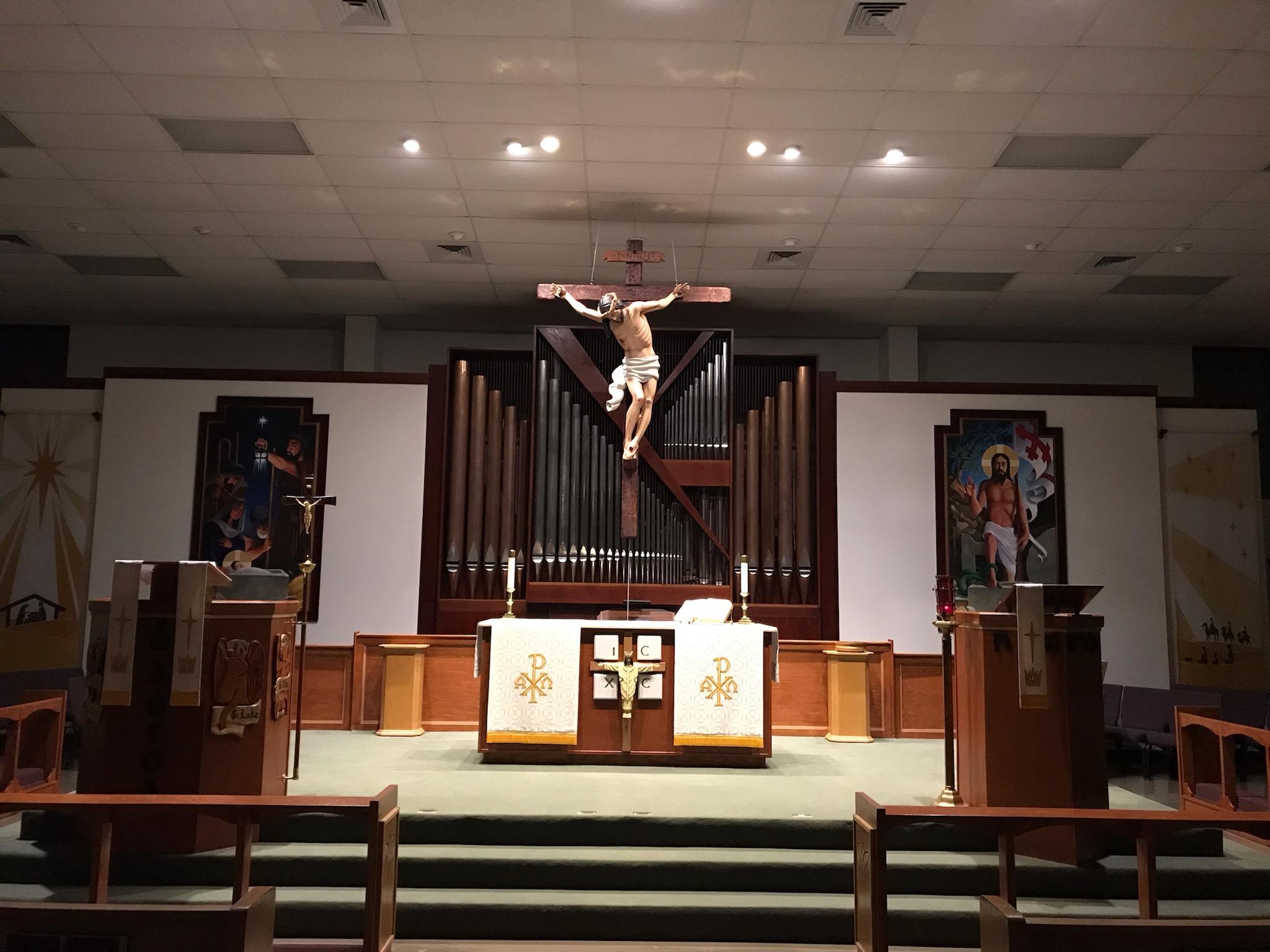
A rightly ordered education drives us in this direction, culminating in the liturgy and sacramental gifts of God. God is, after all, the fullness of truth, goodness, and beauty.
This is why classical Christian education was anchored historically in the life of the church. The liturgical life of the church shaped the life of the school. The church year and daily offices gave rhythm to the school year and school day. Stratford Caldecott contemplates this truth:
A rightly ordered education drives us in this direction, culminating in the liturgy and sacramental gifts of God. God is, after all, the fullness of truth, goodness, and beauty.
This is why classical Christian education was anchored historically in the life of the church. The liturgical life of the church shaped the life of the school. The church year and daily offices gave rhythm to the school year and school day. Stratford Caldecott contemplates this truth:
Human civilization has always been built around an act of worship, a public liturgy. [The Christian liturgy] takes us to the source of the cosmos itself, into the sacred precincts of the Holy Trinity where all things begin and end (whether they know it or not), and to the source of all artistic and scientific inspiration, of all culture.[3]
- Stratford Caldecott
We embrace this heritage at All Saints Classical Academy by:
--Beginning each day with a reverent Matins service tied to the seasonal themes of the church year.
--Recognizing Feast Days and Commemorations of the Saints.
--Correlating our holiday breaks with major festival seasons of the church year.
--Connecting rigorous education to catechesis in the historic Christian faith.
--Embracing our ancient catholic, orthodox, and reformation heritage with its creeds, prayers, and hymns.
We do all of this not just to try and fill students heads with the right ideas or doctrines, but to plant it deep within their bones. There is something more formative and spiritual going on here than just another data download. We are much more than "brains on a stick." We are desiring creatures, worshiping creatures, who by design desire to worship something, anything even--even ourselves. Which is all the more reason to direct those desires Godward. James K.A. Smith explains it this way:
--Beginning each day with a reverent Matins service tied to the seasonal themes of the church year.
--Recognizing Feast Days and Commemorations of the Saints.
--Correlating our holiday breaks with major festival seasons of the church year.
--Connecting rigorous education to catechesis in the historic Christian faith.
--Embracing our ancient catholic, orthodox, and reformation heritage with its creeds, prayers, and hymns.
We do all of this not just to try and fill students heads with the right ideas or doctrines, but to plant it deep within their bones. There is something more formative and spiritual going on here than just another data download. We are much more than "brains on a stick." We are desiring creatures, worshiping creatures, who by design desire to worship something, anything even--even ourselves. Which is all the more reason to direct those desires Godward. James K.A. Smith explains it this way:
A renewal of both Christian worship and Christian education hinges on an understanding of human beings as 'liturgical animals,' creatures who can't not worship and who are fundamentally formed by worship practices. The reason such liturgies are so formative is precisely because it is these liturgies, whether Christian or 'secular,' that shape what we love.[4]
- James K.A. Smith
Which is to say that we are drawn towards specific visions of human flourishing and what it means to have a good life through our imaginations and desires, what we worship and what we deem beautiful--all of which are shaped and formed by the pattern, rituals, routines, and stories we are captured by. Robin Phillips helps explain:
The idols of the materialistic world usually reach our hearts only because they have first captured our imaginations. Now, capturing the imagination is also what a liberal arts education should fundamentally be about. It’s not simply about learning things, but about being nourished, and coming to love what is good, true, and beautiful at a gut level. Put another way, it’s not so much about what the arts are teaching us, but how they are touching us.[5]
- Robin Phillips
Rabbi Heschel came to similar conclusions as well, noting that in a certain sense, “the school is a sanctuary, not a factory,” and that “true learning is a way of relating oneself to something which is both eternal and universal.”[6] Education must capture our imaginations in just such a way, drawing us up into a grander vision. And it does so when its liturgies, patterns, and curriculum echo and align with the church’s liturgy and life. Education for human beings who are desiring creatures, or liturgical animals, as Smith puts it, needs a destiny towards which we march, a telos and ultimate end: the church and her worship. “Education begins in the family and ends in the Trinity,” Stratford Caldecott explains; “the cosmos is liturgical by its very nature.”[7] Schmemann notes similarly how the liturgical life of the church makes “present the One in whom all things are at their end, and all things are at their beginning,” and proclaims “the goal, the end of all our desires and interests, of our whole life, the supreme and ultimate value of all that exists.”[8]
As T.S. Eliot presciently noted nearly a century ago, "Education is a subject which cannot be discussed in a void: our questions raise other questions, social, economic, financial, political. And the bearings are on more ultimate problems even than these: to know what we want in education we must know what we want in general, we must derive our theory of education from our philosophy of life. The problem turns out to be a religious problem.[9] And reconnecting the school and the church is the answer.
For more on bringing the liturgical life into your home, see:
--All the Household
--Will Weedon, Celebrating the Saints
For more on the liturgical and sacramental life of the church, see:
--Joshua Pauling, "On the Day Called Sunday: Reclaiming Biblical Worship and Discipleship"
--Joshua Pauling, "You Are What You Believe: How the Creed Defines Our Identity"
For more on the connections between worship and education, see:
--Stratford Caldecott, Beauty in the Word
--Stratford Caldecott, Beauty for Truth's Sake
--James K.A. Smith, Desiring the Kingdom Series
As T.S. Eliot presciently noted nearly a century ago, "Education is a subject which cannot be discussed in a void: our questions raise other questions, social, economic, financial, political. And the bearings are on more ultimate problems even than these: to know what we want in education we must know what we want in general, we must derive our theory of education from our philosophy of life. The problem turns out to be a religious problem.[9] And reconnecting the school and the church is the answer.
For more on bringing the liturgical life into your home, see:
--All the Household
--Will Weedon, Celebrating the Saints
For more on the liturgical and sacramental life of the church, see:
--Joshua Pauling, "On the Day Called Sunday: Reclaiming Biblical Worship and Discipleship"
--Joshua Pauling, "You Are What You Believe: How the Creed Defines Our Identity"
For more on the connections between worship and education, see:
--Stratford Caldecott, Beauty in the Word
--Stratford Caldecott, Beauty for Truth's Sake
--James K.A. Smith, Desiring the Kingdom Series
[1] T. S. Eliot, Selected Essays (NY: Harcourt, Brace, & World, 1964), 460.
[2] Alexander Schmemann, For the Life of the World: Sacraments and Orthodoxy (NY: St. Vladimir’s Seminary Press, 2018), 92.
[3] Caldecott, Beauty for Truth’s Sake, 125.
[4] Smith, Imagining the Kingdom, 4.
[5] Phillips, “More than Schooling.”
[6] Abraham Joshua Heschel, The Insecurity of Freedom: Essays on Human Existence (NY: Farrar, Straus & Giroux, 1967), 42.
[7] Caldecott, Beauty for Truth’s Sake, 17.
[8] Schmemann, For the Life of the World, 36–38.
[9] Eliot, Selected Essays, 452.