
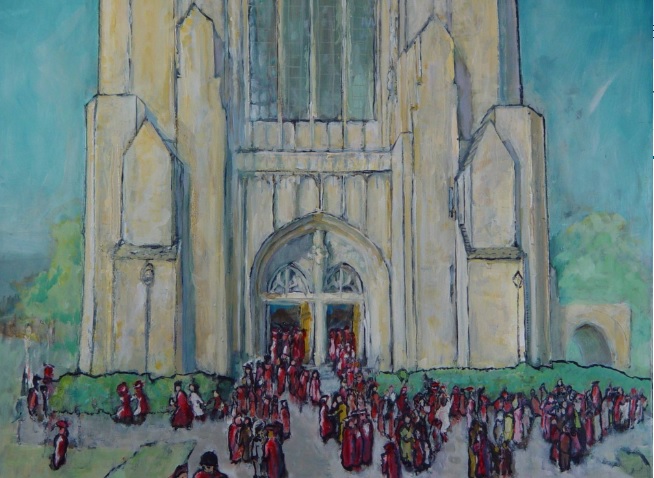

Summer is not only a time of refreshment, but also a time of new beginnings. It's graduation season, filled with ceremonies and commencement addresses. Over the years, I've had the honor of delivering a few commencement addresses. Delivering a charge to a group of high school graduates is a sobering task. What do we hope for them? What will their future look like? And, similarly, what do we want for our students here at All Saints Classical Academy as they grow and mature? Below is a manuscript of a commencement address I delivered on May 17, 2025.
Congratulations to you all on this day of celebration. What to say to this group, who was a joy to work with, the highlight of my week, most weeks. What to say to this group, who energized me with their discussions and wit, who challenged my thinking as I challenged theirs.
This is when I am supposed to recite pious platitudes from Hallmark cards, repeat stock cliches from motivational posters, rehearse sappy sayings from graduation songs, or recycle trite truisms from Dr. Suess’s Oh the Places You’ll Go. This is when I am supposed to say how you are all the best ever, how you will go out and change the world, how you should reach for the stars and dream big, find the cure for cancer, and bring about world peace. Well, you’re not going to get that today. Sorry, not sorry. Because you know as well as I do that those things ring hollow when life gets hard. And life will get hard—many of you already know this.
Furthermore, the “dream big,” and “you’re the best” message frequently leaves graduates jaded and cynical when they realize in their twenties that they have neither changed the world nor fulfilled those big dreams, and that they’re not really the best after all. Such messaging might give you warm fuzzies on graduation day, but it gives you false expectations of what adulthood is and what a meaningful life actually is.
So let’s skip the flattery and cut right to the chase: Graduates, now the real, hard work begins: making it into adulthood.
Adulthood has turned into a despised and foreign concept today. So much so that when people of adult age actually do adult things like pay bills and get their cars fixed, there’s a verb to refer to it: “adulting.” In our culture this transition to adulthood is indeed fraught with many traps and enticements. As you graduate, I suggest the following four things to help you make it to adulthood, and not end up stuck in permanent teen status.
First, take on additional responsibilities with increasing depth and purpose.
It’s very easy for your transition to adulthood to get bogged down in choice paralysis, the experience of too many choices, endless careers or colleges or majors or potential spouses, let alone the endless choices at the grocery store or on amazon. When all paths and options are presented as open and available, choosing one path feels impossible. You freeze up. You fail to act. You get nervous about closing off other potential paths.
You can avoid such choice paralysis by recognizing there is more than one perfect career path or college or job for you. There is more than one ideal life for you. As long as your decisions are within the bounds of the 10 Commandments and you don’t ignore your responsibilities as a child, sibling, citizen, and Christian, you are free to just make a wise choice and move on with life.
Avoid choice paralysis by increasing your responsibilities in your home, community, and church, and in your next phase of life as an employee, student, or both. Take on additional financial responsibilities. Then, add more responsibilities to that. This is how we become adults – by practicing. When you were a kid, you played “grown-up” all the time. We need to keep practicing being “grown-up” for it to actually happen.
Second, think beyond careers.
Yes, careers are important, but they are not the most important thing in your life, and if the data holds true, many of you will change careers multiple times. What is more important are the other “jobs” that outlast careers. The job of being a son or daughter, of being a mother or father, of being a member of a community. These are the jobs—the callings from God—that you can’t get out of or retire from. And when you reach your deathbed, these are the jobs and callings you will be thinking about – not how you scored so high on the SAT, or had fun in college, or made so much money in your career. Instead, it will be the permanent things that come to mind.
Don’t fall into the career-centered trap or get misled by the culture that tells you to focus on yourself, to be yourself, to love yourself. We don’t need help with that – we’re already self-centered enough. Instead, we need to be brought beyond ourselves to the love of others. Don’t put self-interest before this great opportunity and great gift. And don’t delay in this. While you’re trying to live for yourself, or get your career all perfectly figured out, life and a possible spouse may have passed you by in the meantime.
Third, be prepared to suffer.
Back in 2017, one of our nation’s Supreme Court justices was asked to speak at his son’s graduation. How about that for a graduation speaker! You got stuck with me…sorry. The Supreme Court justice surprised his audience with the message he gave those graduates. Here’s what he said: “From time to time in the years to come, I hope you will be treated unfairly, so that you will come to know the value of justice. Sorry to say, but I hope you will be lonely from time to time so that you don’t take friends for granted. I wish you bad luck, again, from time to time so that you will be conscious of the role of chance in life and understand that your success is not completely deserved and that the failure of others is not completely deserved either…From time to time…I hope you’ll be ignored so you know the importance of listening to others, and I hope you will have just enough pain to learn compassion. Whether I wish these things or not, they’re going to happen. And whether you benefit from them or not will depend upon your ability to see the message in your misfortune.”[1]
Harsh words? No, honest words. Words that remind us that we don’t become stronger, more resilient human beings by avoiding failure or shying away from hardship. We become stronger by embracing difficulty and responsibility. For it is through such struggle that we acquire strength, maturity, and virtue.
Life will be filled with difficulty, suffering even, and yes, evil things that are hard to explain. You have all experienced this to one degree or another thus far in your life. There will be more of it.
Yet, Christians have a unique approach to suffering. We don’t dismiss it stoically or pretend it isn’t happening. We don’t try and think positively to magically wish it away. We don’t determine whether God is happy with us based on how good or bad our circumstances are – that is disastrous and leads only to pride or despair. Instead, we mourn, we lament, we hope. For Christ is actually found most fully in suffering and in weakness. Christ has taken into his very body all the evil, suffering, and sin of every one of us and of the whole world. And his bodily resurrection from the dead in actual real history guarantees that what Christ bore fully in his very body, soul, and heart was for you. And so, we honor, celebrate, and bow before the suffering God and his cross, and we too bear in our own bodies an extension of Christ’s sufferings, which bears his name to the world.
“The way of the Christian life is cruciform. Jesus did not suffer and die in order that we need not suffer and die, but in order that our suffering and death might be joined to his in redemptive victory.”
Which leads me to my fourth and final point, stay connected to Christ.
There is no secret, super-spiritual way to stay connected to Christ. We stay connected to him through his gifts of Word and Sacrament, prayer and fellowship, as we daily repent of our sins and receive God’s forgiveness to live by his Word. That’s it. You don’t have to magically find out God’s will for your life and hope you read the tea-leaves correctly or sense his leading with some superhero spidey-sense. Christ has already told you all that needs to be said. And done all that needs to be done. He has given you his perfect life and death, and by grace, through faith, you are united to him in resurrection life. This is your true identity. Strengthen it. Remember it. Feed it by staying connected to Christ’s church and the gifts he gives you there through the preaching of the Word and the gifts of baptism and communion. Submit yourself to a local body, ahealthy church community that can counteract the shifting cultural sands around you with a stability grounded in the truth of Christ, the world’s rightful King who redeems you and remakes the world.
Conclusion
None of what I’ve said here is earth-shattering or glamorous. It’s mundane, yet miraculous; ordinary, yet extraordinary. For it is, after all, what actually changes the world, one tiny step, one person at a time. No shortcuts or life hacks here. No self-help gurus or efficiency apps required.
While it’s easy to dream about exotic pilgrimages or celebrity influencer-inspired lifestyles, it’s actually the boring stuff that brings joy.
So, dear graduates: Take on responsibility. Think beyond careers. Be prepared to suffer. Stay connected to Christ.
Get married. Have children. Go to church. Practice the faith. Put down the phone. Read a book. Skin your knee. Hold someone’s hand. Pick up the paintbrush, the ball, the instrument. Choose the hard thing, not the easy thing. For the virtuous life requires that you don’t choose the path of least resistance but the path of more resistance.
There is an old Eastern proverb about teaching: that the student and the teacher walk the same path, and that the student surpasses the teacher on that path.
I see that in you all; keep traveling the path, and I will see you along the way—I can still be a traveling companion. And you will find other traveling companions too – some your age, some younger, some older; some living, some dead (especially those ancient church fathers I mentioned so many times this year!).
No matter what your job and callings end up being, embrace the lifelong call to be a teacher and a learner, with yourself, with your own children, with those around you. Bring them along the path with you. Inspire others to join the chase into what is true, good, and beautiful, into what is eternal and lasting, into what all culminates in Christ the Master Teacher, in whom we have redemption and reunion by grace through faith, as he brings us with him up into the divine life of the Holy Trinity, an eternal path of love and joy, of perfection and exhilaration, of knowing and being known!
For that is your destiny, dear graduates, that is what you were made for. And I want to see you there on the last day, Amen.
[1] J. Haidt, The Coddling of the American Mind, 193.