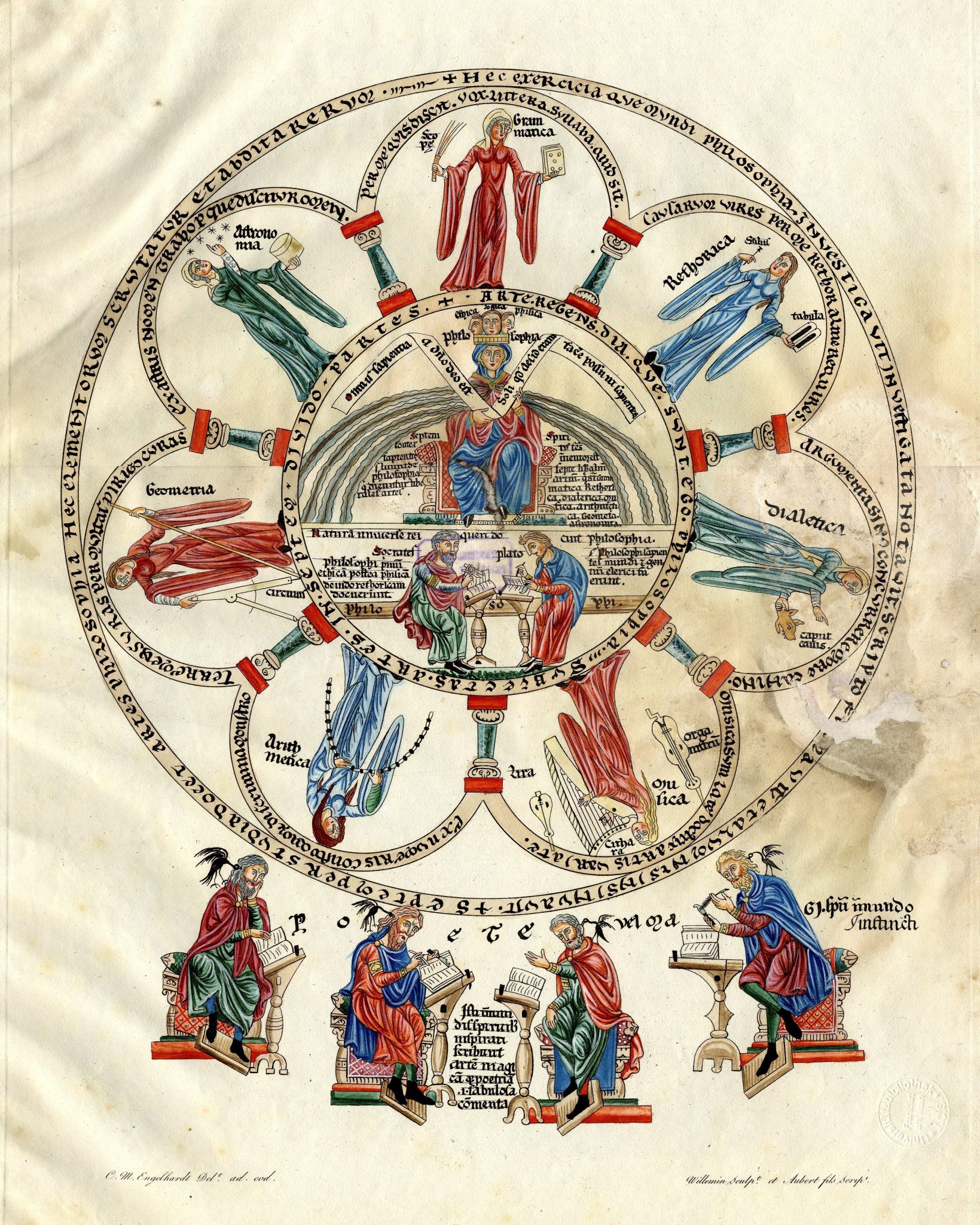

When we think of the liberal arts today, we most likely think of the humanities--subjects like Literature, English, History, and Philosophy. Or we might think of liberal arts colleges, where students are required to take a certain number of classes in the humanities or other courses with similar designations. But this is only partially right historically. The term liberal arts comes from the Latin ars liberalis, meaning the arts and skills of a free or liberated person. Contained within the liberal arts were skills of language, skills of number, and skills of science (or as it was called at the time, natural philosophy). The liberal arts were not just the humanities, subjects people studied if they weren't "a math person." Everyone who studied the liberal arts was a math person--and a language person as well. This common distinction we make today is was a false dichotomy to the ancients. A perfect example of this is the great philosopher Plato, who at his Academy, had above the door, "Let only mathematicians enter here." What many people don't realize is that Plato was just as much a mathematician as a philosopher. They were not at odds with each other, but fed and built upon each other, leading Plato to be the great mind he was.
There are traditionally seven liberal arts, grouped under two headings:
The Trivium (which means the three ways/roads)
--Grammar
--Dialectic
--Rhetoric
These three are the arts and skills of language, primarily. To use Stratford Caldecott's terminology, these three have to do with knowledge, thinking, and communicating. I like to think of the Trivium as the way of the Logos, where we understand words, learn their meaning, learn to wield them well, and are formed by them. We also have:
The Quadrivium (which means the four ways/roads)
--Mathematics (number in the abstract)
--Geometry (number in space)
--Music (number in time)
--Astronomy (number in space and time)
These four are the arts and skills of number and science, primarily. But not narrowly understood. You can see that music is included, and is central to the overall approach. Music reveals a harmony, beauty, and order to math, science, the universe, and all of it is beautiful to the mind, ear, and eye. Even the universe itself has been set to music, as the ancient called it, the music of the spheres. I like to think of the Quadrivium as the way of the Cosmos, where we understand the world, its inner working, its structure, its maker. Together, you might even say that the Trivium and Quadrivium help us to better read God's two books as Aquinas called them: the Book of Scripture and the Book of Nature.
It is also important to note that these seven liberal arts were never understood to be the complete curriculum. These seven liberal arts were situated in a larger educational approach that included physical training (gymnastic), religious and familial training (piety), the development of bodily skills for work in the world (the common arts), and the study of higher sciences, philosophy, and, theology (called the queen of the sciences--science literally means "knowledge"). Caldecott's words are fitting in conclusion:
For more on this topic, see:
--Ravi Jain and Kevin Clark, The Liberal Arts Tradition
--Stratford Caldecott, Beauty in the Word
--Stratford Caldecott, Beauty for Truth's Sake
[1] Caldecott, Beauty in the Word, 10.